
Overview
Cohen Milstein, as interim co-lead counsel, represents consumers in a putative antitrust class action against potato processing giants, McCain Foods, Lamb Weston, J.R. Simplot, Cavendish Farms, and third-party data analytics company, Circana, for allegedly conspiring to fix the prices of the market for frozen french fries, hash browns, tater tots, and other frozen potato products.
Plaintiffs allege that the potato processing defendants, whose sales account for nearly 98% of the $68 billion annual market for frozen potato products in the U.S., leveraged their market leadership to share competitively sensitive data in order to fix the prices of frozen potato products at artificially inflated levels since 2021.
Rather than compete on price, the potato processing defendants were careful to ensure that any price increases were matched by their ostensible competitors.
Multiple industry insiders confirmed that these price increases harmed both restaurants and retail (e.g., grocery stores) distribution channels, and ultimately indirect purchasers—individual consumers – like the plaintiffs.
Important Rulings & Dates
- On February 27, 2026, the U.S. Department of Justice filed a statement of interest in the lawsuit.
- On August 20, 2025, Cohen Milstein was appointed interim co−lead counsel for the Consumer Plaintiffs.
Case Background
Four companies — McCain, Lamb Weston, J.R. Simplot, and Cavendish Farms— dominate the market for frozen potato products. They account for nearly 98% of the $68 billion annual market for frozen potato products in the United States.
These four companies further benefit from their leadership in trade associations like the National Potato Promotion Board, in which several executives serve on the board, and which serve to facilitate regular opportunities for in-person executive meetings and conversations. In addition, a third-party data analytics company, Circana, offered in-depth reports on the frozen potato products market through its program “PotatoTrack.” These reports provided the processor defendants unique insights into one another’s pricing strategies, output, product lines, and even market share.
Plaintiffs allege that the defendants have leveraged their market leadership, these discreet relationships, and competitively sensitive data, to fix the prices of frozen potato products at artificially inflated levels.
For example, plaintiffs claim that in one remarkable five-day stretch in February 2022, all four potato processors announced nearly identical price hikes of roughly 12 cents per pound on their frozen potato products. In April 2022, the potato processors announced another set of uniform price increases. Multiple industry insiders confirmed that the defendant processors’ price increases impacted both their foodservice (e.g., restaurants) and retail (e.g., grocery stores) distribution channels. Industry insiders reported that price increases always (or nearly always) impacted both distribution channels.
Plaintiffs further claim that these were not the only coordinated price hikes of this kind. On at least four other occasions—in January 2021, February 2021, May and June 2021, and October 2021—the potato processors issued substantially identical price hikes on frozen potato products at nearly exactly the same time.
Plaintiffs also claim that all of this occurred even as the input costs for frozen potato products declined dramatically.
This combination of coordinated price hikes and declining costs led to unprecedented profit margins, as demonstrated by the following graph, which compares movement in the price of frozen potato products to movement in relevant input costs.
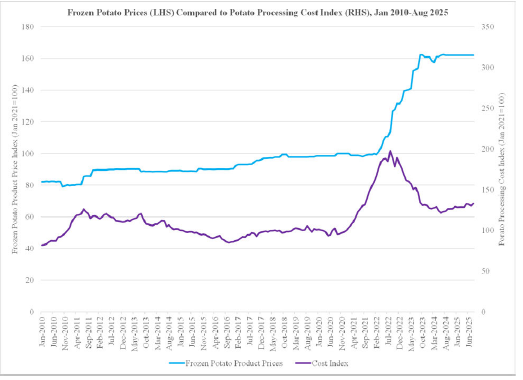
Plaintiffs claim that defendants secured those margins through their multi-faceted conspiracy to fix the prices of the frozen potato products market.
Plaintiffs bring this proposed class action on behalf of indirect purchasers of frozen potato products—individual consumers who purchased everyday products like frozen french fries, tater tots, and hash browns for their own personal consumption. Plaintiffs seek equitable and monetary relief, and to restore competition in the marketplace.